Beyond the $60 Lesson: How Piano Teachers Are Building Real Income in 2025
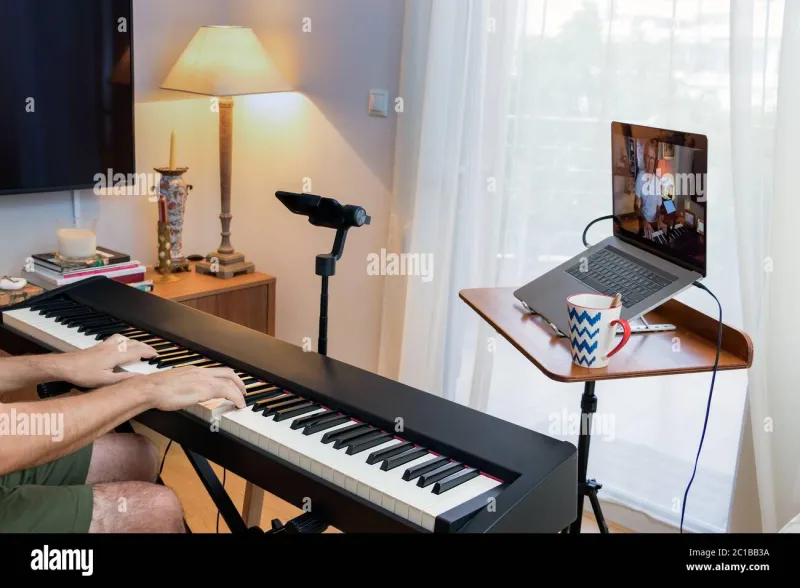
Photo: piano teacher recording online lesson video content at home studio, via c8.alamy.com
For most of its history, piano teaching has operated on a simple, somewhat exhausting model: trade your time for money, one student at a time, until your schedule is full and your wrists ache. It's a profession built on passion, but the economics have always been tight. Fill 30 slots a week, charge $65 a lesson, and you're looking at a ceiling somewhere around $100,000 — before taxes, before expenses, before the inevitable cancellations.
But something is shifting. A new generation of piano educators is refusing to accept that ceiling, and they're finding creative, sustainable ways to scale their expertise without simply adding more hours to an already packed week.
The Pivot Point
Marcus Webb had been teaching piano in Austin, Texas for nine years when the pandemic forced him to rethink everything. Like most teachers, he scrambled to move lessons online in March 2020. What he didn't expect was that the shift would open up an entirely different vision of what his career could look like.
"I started recording supplemental videos for my students — little tutorials on technique, theory breakdowns, that kind of thing," he says. "Then I thought, why not post these publicly? Within six months I had a YouTube channel with 8,000 subscribers. That changed the whole game for me."
Today, Webb earns roughly 40% of his income from sources that don't involve sitting at a piano with a student. His YouTube ad revenue, combined with a Patreon membership community and an online course on jazz harmony, consistently brings in $3,000–$4,000 a month — on top of a scaled-back private lesson schedule that he now keeps intentionally smaller.
"I work fewer hours than I did in 2019, and I make more money," he says. "I also enjoy teaching more, because I'm not burned out."
Online Courses: The Passive Income That Isn't Quite Passive
The online course market for music education has exploded over the past five years. Platforms like Teachable, Thinkific, and even Udemy have made it relatively straightforward for educators to package their knowledge into structured, sellable curricula.
The catch? Building a course that actually sells takes real work upfront. Teachers who've succeeded in this space are consistent about one thing: specificity wins.
"A course called 'Learn Piano' will get lost," says Jamie Okafor, a piano educator in Charlotte, North Carolina who launched her first course — focused entirely on adult beginners returning to the instrument after decades away — in 2022. "But 'Piano for the Rusty Adult: Get Back to Playing in 30 Days' speaks directly to a real person with a real problem. That's who buys."
Okafor's course, priced at $197, has sold over 600 copies with minimal ongoing promotion. She's since added a second course on reading sheet music for self-taught players. Combined, they add roughly $1,500–$2,000 a month to her income.
The key insight: teachers don't need massive audiences to make online courses work. A focused, well-priced course marketed to the right niche can generate meaningful revenue even with a modest following.
Group Masterclasses and Workshops
One-on-one instruction is inherently limited by time. Group formats break that constraint entirely.
Monthly online masterclasses — live, interactive sessions covering specific topics like sight-reading, performance anxiety, or playing by ear — are becoming a popular offering among piano educators with established audiences. At $25–$75 per attendee, a single 90-minute session with 20 participants can generate more revenue than a full day of private lessons.
In-person workshops at local music schools, libraries, community centers, and even corporate campuses are another avenue. Several teachers interviewed for this piece have developed "Piano for Beginners" weekend workshops that attract adult learners who want a structured introduction without committing to ongoing lessons. These typically run $75–$150 per participant for a half-day format.
The Corporate Wellness Angle
This one surprises people, but it's gaining real traction: corporate wellness programs.
Companies across the US are expanding their employee wellness offerings beyond gym memberships and meditation apps. Music-based programs — stress reduction through piano, lunchtime music workshops, team-building through group music experiences — are a growing niche that some piano educators are stepping into.
Teachers who've pursued this space say the key is reframing what you offer. You're not selling piano lessons; you're selling a structured, creative wellness experience that reduces stress, improves focus, and builds team cohesion. That's a pitch that resonates with HR departments, and the rates reflect it — corporate engagements often command $150–$300 per hour, far above standard lesson rates.
Content Creation as a Long-Term Asset
Not every piano teacher wants to be a YouTuber, and that's completely valid. But building some form of content presence — whether that's a YouTube channel, an Instagram account focused on teaching tips, a newsletter, or a podcast — creates compounding value over time.
Content attracts students, builds credibility, and opens doors to brand partnerships, affiliate revenue, and speaking opportunities that simply don't exist for teachers with no public presence. Several piano-focused educators have landed partnerships with instrument brands, software companies, and online learning platforms after building audiences in the tens of thousands.
The investment is time, not money. And the returns, while slow to materialize, can be substantial.
Building the Hybrid Model
The most successful piano educators aren't abandoning private lessons — they're building around them. The emerging model looks something like this: a manageable core of private students (often their most advanced or committed ones), supplemented by a mix of online courses, group offerings, content revenue, and occasional corporate or event work.
This hybrid approach solves the fundamental problem with traditional piano teaching: income that scales with effort rather than with hours. When a course sells while you sleep, or a YouTube video earns ad revenue years after you posted it, your income is no longer capped by the number of hours in your week.
For piano teachers who've spent years giving everything to their students, building something that also gives back to them isn't a betrayal of the craft. It's a sustainable way to stay in it for the long haul — and to keep loving every minute at the bench.