One Piano Was Never Going to Be Enough: Inside the Collector's Mind of the Serious Piano Teacher
Somewhere in America right now, a piano teacher is explaining to their partner why the living room needs to accommodate a second grand. The explanation involves acoustics, pedagogy, and something about a once-in-a-lifetime Craigslist deal. The partner has heard this before. So has the neighbor whose driveway got blocked by the piano movers.
If you teach piano — or you've been playing seriously for more than a decade — there's a decent chance you've already crossed the threshold from "musician with a piano" into "person with a piano situation." It happens gradually, then all at once. And honestly? You're not alone.
How It Usually Starts
The first acquisition is always logical. You need something to practice on. Done. But then a student mentions their grandmother is getting rid of a Baldwin upright, and it's free if you can haul it. Free piano. You're not a monster. You take it.
Maybe the second one is a digital — good for late-night practice without waking the kids. The third is a project piano, a beat-up spinet you swore you'd restore. The fourth arrives because a colleague is downsizing and offers you their studio Yamaha at a price that felt criminal to refuse.
Suddenly you have four pianos, and your garage has become a climate-controlled holding facility that also happens to store holiday decorations.
Piano teachers are especially vulnerable to this pattern. Unlike, say, guitarists — who can tuck a dozen instruments into a back bedroom without anyone noticing — piano collectors are playing a spatial chess game with furniture that weighs anywhere from 300 to 1,200 pounds. Every new acquisition is a commitment. And yet, the pull is real.
The Psychology Behind the Accumulation
There's actually something pretty understandable going on here. For teachers, each piano in the collection often serves a distinct purpose, at least in their heads. One is the "good" piano — the one students play during lessons. Another is the practice instrument, because you'd rather not put daily wear on the nice one. A third might be tuned to a different pitch for historical repertoire. A fourth is "in progress."
That's not hoarding. That's specialization. (That's what we tell ourselves, anyway.)
Beyond utility, there's a genuine emotional dimension. Pianos carry history. A teacher who rescues a neglected instrument from a church basement or a storage unit isn't just acquiring a piece of furniture — they're preserving something. There's a caretaker instinct baked into a lot of serious musicians, and pianos have a way of triggering it hard.
There's also the collector's high, which anyone who's spent time on eBay or at estate sales will recognize. Finding a deal on a quality instrument — especially one with a name like Bösendorfer, Mason & Hamlin, or even a mid-century Steinway console — produces a very specific kind of satisfaction. It's part connoisseurship, part treasure hunting.
When Multiple Pianos Actually Make Sense
Let's be fair: there are genuinely good reasons to own more than one piano.
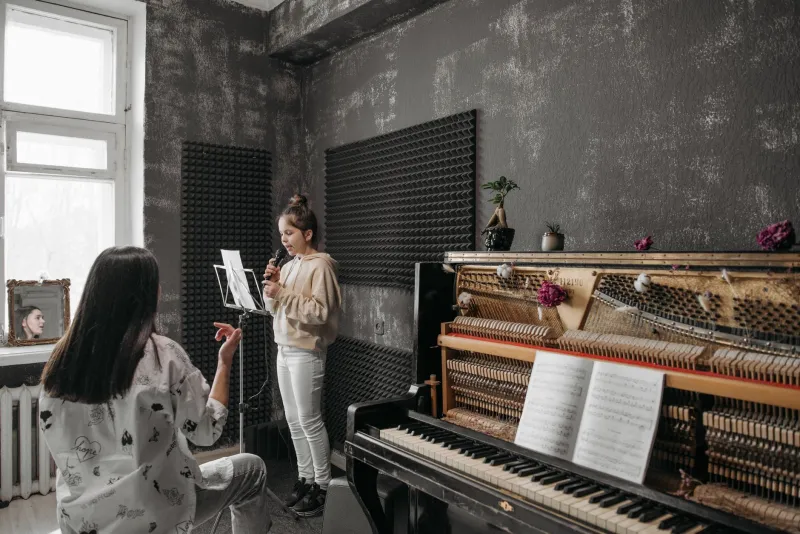
Teaching studios often benefit from having two instruments. A teacher-student duet setup — where both sit at a piano simultaneously — is a legitimate and effective teaching method. Some studios keep a grand for performance work and an upright for beginner drills. That's not excess; that's infrastructure.
Acoustic vs. digital is another common split. A quality acoustic for the core practice, a digital for late nights, headphone sessions, or recording. Many serious players consider this combination the sweet spot — the best of both worlds without having to choose.
Restoration projects have their own logic, as long as you're honest about the timeline. If you're genuinely working on a piano — getting it tuned, repaired, refinished — it's a project. If it's been sitting untouched for three years and you've stopped making eye contact with it, that's a different conversation.
When the Collection Becomes the Problem
Here's where things get real. Pianos require maintenance. Tuning alone runs $100–$200 per visit, and most instruments need it at least twice a year. Multiply that by four pianos and you're looking at close to $1,600 annually just to keep everything in pitch — assuming nothing needs regulation, voicing, or repair.
Then there's the space issue. Pianos don't stack. They don't fold. They don't go in a closet. Every piano you own is occupying real square footage in your home or studio, and that square footage has a cost, whether you're paying rent or a mortgage.
Humidity is another headache. Wood and felt don't love temperature swings or dry winters, which means you're either investing in climate control systems or watching your instruments slowly deteriorate. A piano left in an unheated garage in Minnesota is not a piano — it's an expensive woodpile in progress.
And then there's the social cost, which is harder to quantify but very real. Relationships have been tested by piano accumulation. Moving days are stressful enough with one grand; three pianos and a studio move can push even the most patient friends to their limits.
A Practical Gut-Check for Piano Collectors
Before you say yes to the next instrument that crosses your path, run through a quick mental checklist:
- Do you have a specific use for it? Not a vague future use — an actual, current need.
- Can you afford the ongoing maintenance? Be honest. A piano you can't maintain is a piano in decline.
- Do you have the space? Not "technically" — genuinely comfortable space that doesn't make your home feel like a warehouse.
- Is this a rescue or a rationalization? There's a difference between saving a quality instrument and collecting guilt about neglected ones.
- What would you give up for it? If the answer is nothing, that's a green light. If the answer is "my partner's home office" or "the kids' playroom," pump the brakes.
Making Peace With Your Piano Situation
If you've already got a small fleet of instruments and you're wondering what to do, you've got options. Selling is the obvious one — and the market for quality used pianos is actually pretty healthy right now, especially for well-maintained uprights and consoles. A piano that's been tuned regularly and lives in a good environment can fetch a fair price.
Donating is another route. Schools, community centers, churches, and music programs are often looking for instruments, and you'll likely get a tax deduction for the appraised value. Not a bad deal.
Or, you know, you keep them. You accept that you are a person who owns four pianos, that this is simply who you are, and you schedule the tuner for all of them in the same week to save on trip fees.
There's no shame in it. Some people collect vintage cars. Some people collect cast iron. Piano teachers collect pianos. At least yours make music.
Just maybe hold off on the fifth one until you've had a serious conversation with your floor joists.