Running on Empty: Recognizing Piano Teacher Burnout Before It Breaks You
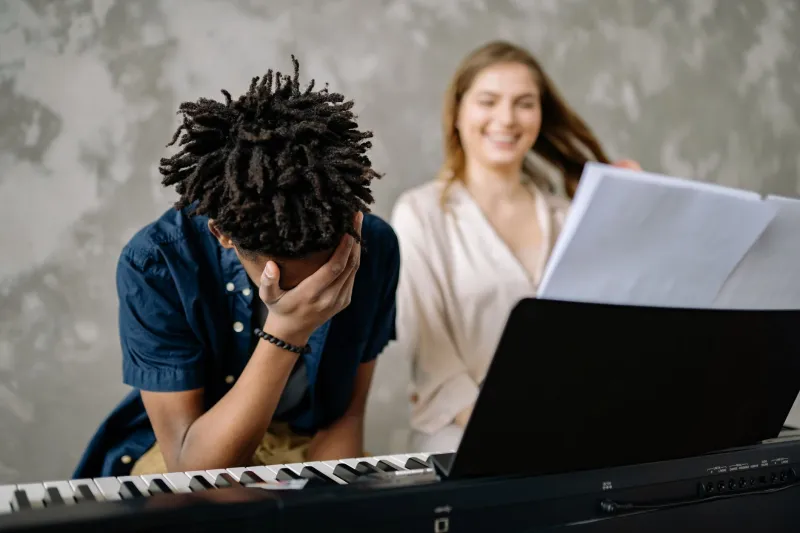
There's a moment that many piano teachers describe almost identically, even though they've never compared notes. It usually happens on a Tuesday or Wednesday afternoon, somewhere in the middle of a back-to-back teaching block. A student sits down at the bench, positions their hands, and begins playing — and the teacher feels nothing. Not frustration, not pride, not even mild interest. Just a kind of hollow, muffled silence where the love of music used to live.
That moment is burnout knocking.
For independent piano teachers across the United States, burnout isn't a rare edge case. It's a predictable occupational hazard that the industry talks about far too little. And unlike burnout in a traditional office job, it carries a particular sting: you chose this. You built this. You love music. So what does it mean when the thing you love starts to feel like a weight you're dragging?
What Burnout Actually Looks Like in This Field
Burnout in piano teaching doesn't always announce itself loudly. It rarely shows up as a dramatic breakdown. More often it's a slow accumulation of small signals that are easy to rationalize away.
Physically, teachers report chronic fatigue that doesn't resolve with rest, recurring tension in the neck, shoulders, and wrists, and a low-grade headache that seems to live permanently just behind the eyes. "I thought I was just tired," says Rachel, a piano teacher in Nashville who has been teaching independently for eleven years. "I kept telling myself I needed a vacation. But I took a vacation and came back feeling exactly the same."
Emotionally, the signs are subtler but arguably more alarming. Decreased patience with students — especially beginners — is one of the earliest. So is a growing sense of dread before the teaching day begins, a feeling that's hard to distinguish from ordinary Monday-morning reluctance until you realize it's happening every day, including days you used to look forward to.
Cynicism is another marker. When you start internally rolling your eyes at a student's excitement, or find yourself going through the motions of encouragement without meaning any of it, that's not just a bad week. That's a warning sign.
Why Piano Teachers Are Particularly Vulnerable
Every profession has burnout risk, but independent music educators carry a specific combination of stressors that makes them especially susceptible.
First, there's the isolation. Most piano teachers work alone, without colleagues to vent to, without a manager to flag concerns, without a built-in support structure. When something goes wrong — a difficult student, a family dispute over lesson policies, a month of cancellations — there's no one in the next office to commiserate with.
Second, there's the emotional labor that doesn't show up in the job description. Piano teachers aren't just teaching scales and repertoire. They're managing the anxiety of nervous students, navigating the expectations of involved parents, and absorbing the emotional energy of dozens of individuals every week. That's exhausting in ways that are genuinely hard to quantify.
Third — and this one is tricky — many piano teachers have a complicated relationship with their own musical identity. Teaching can feel like a compromise, even when it isn't. The gap between the performer or musician you imagined being and the teacher you became can quietly feed resentment, even in people who genuinely love teaching.
"I didn't realize how much unprocessed grief I was carrying about not pursuing performance more seriously," admits Daniel, a piano teacher in Chicago who began working with a therapist specializing in musicians three years ago. "It was leaking into my teaching in ways I couldn't see until someone pointed it out."
The Therapist's Perspective
Therapists who work specifically with musicians and music educators point to a few patterns they see repeatedly.
One is what they call "helper fatigue" — the exhaustion that comes from being in a perpetually giving role without adequate reciprocal support. Another is perfectionism that gets turned inward: teachers who hold themselves to the same exacting standards they'd apply to a performance, beating themselves up over lessons that didn't go the way they'd planned.
"The piano teachers I work with are often the last people to give themselves grace," says one therapist based in Los Angeles who works primarily with performing artists and educators. "They're incredibly compassionate with their students and incredibly harsh with themselves."
The good news: burnout is not a permanent state. It's a signal. And signals, when you hear them early enough, can change your direction before you crash.
Catching It Early: Practical Checkpoints
The teachers who navigate burnout most successfully tend to have one thing in common: they treat their own wellbeing as a non-negotiable part of their professional practice, not an afterthought.
A few strategies that come up consistently:
Cap your student load before you think you need to. The impulse to take on one more student, especially when money is tight, is understandable. But most experienced teachers point to overloading as the single fastest path to exhaustion. Know your sustainable number and hold it.
Build genuine recovery time into your schedule. Not just gaps between lessons — actual time away from the instrument, away from music admin, away from anything teaching-related. "I started taking every Sunday completely off from anything piano-related," says Rachel. "No lesson prep, no emails, no practicing. It felt indulgent at first. Now I think it's the only reason I'm still teaching."
Play for yourself, regularly. This sounds obvious, but it's one of the first things to disappear when life gets busy. Keeping your own musical life alive — playing repertoire you love, exploring new pieces, even just noodling without any goal — is protective in ways that are hard to overstate.
Talk to other teachers. Local music teacher associations, online communities, even an informal group text with a few trusted colleagues — connection with people who understand your specific experience is genuinely therapeutic.
If You're Already There
If you're reading this and recognizing yourself in the warning signs, the most important thing to know is that taking a step back is not failure. Restructuring your studio, reducing your hours, raising your rates to teach fewer students at a higher income — these aren't signs that you couldn't hack it. They're signs that you're paying attention.
Music education loses good teachers every year, not because those teachers stopped loving music, but because they ran out of road before anyone helped them find a different route. You don't have to be one of them.
The piano will still be there. Make sure you will be too.